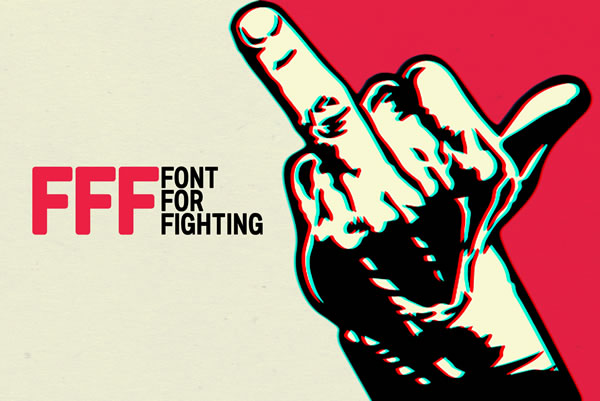
Font for Fighting: A Type Face Designed for Resistance
Andrea Gaspari created Font for Fighting because we all know that a "NO" written in Comic Sans is like saying that you are lactose intolerant while stuffing a french cheese in your face. It lacks conviction. It undermines the message. It whispers when you need to shout. In a world saturated with polite, rounded, and overly friendly typography, sometimes you need a visual voice that has a backbone. This typeface is not just a collection of letters; it is a statement piece, a digital megaphone for those moments when polite suggestions aren't enough.
A Visual Style That Refuses to Back Down
At its core, Font for Fighting is a premium font that bridges the gap between aggressive punk aesthetics and legible modern design. It is not a chaotic handwritten font that looks like a doctor’s prescription, nor is it a sterile sans serif font that blends into the background. Instead, it possesses a distinct, gritty personality. You will likely notice sharp angles, heavy ink traps, and a texture that feels like it was printed on a Risograph or sprayed onto a brick wall. It carries the weight of a serif font in terms of impact but maintains a modern edge that keeps it from looking archaic.
The visual characteristics of this typeface are built for high-stakes environments. It has a boldness that commands immediate attention, making it a formidable display font. It isn't designed for body copy in a legal document, but rather for the headlines that scream for justice, the packaging that demands to be picked up, and the social posts that stop the endless scroll. It balances on the razor's edge between being a creative font and a functional tool for rebellion.
Where to Deploy the Weaponry
Understanding where to use Font for Fighting is about understanding context and contrast. In brand identity, this typeface is perfect for brands that position themselves as disruptors, activists, or alternative culture icons. If you are launching a streetwear line, a skate brand, or an independent zine, this font instantly signals that you are not part of the corporate machine. It brings an authenticity to logo design that polished geometric fonts simply cannot achieve.
For packaging design, particularly in the craft beverage, hot sauce, or artisanal goods market, this font provides shelf appeal. It suggests that the product inside is bold, handmade, and unapologetic. It works exceptionally well in editorial design for magazine headers, pull quotes, or feature stories dealing with intense subject matter. Furthermore, in the realm of web design, it serves as a powerful tool for hero sections and call-to-action buttons. When a user lands on a page and sees Font for Fighting, they understand immediately that the brand has a distinct point of view.
Even for personal projects, such as protest posters, concert flyers, or personal blogs about social issues, the font adds a layer of urgency. It transforms social media graphics from standard announcements into rallying cries. It is a versatile design asset for anyone needing to cut through the noise.
Mastering the Art of Typographic Conflict
Using a font with this much personality requires a strategic approach to modern typography. The most critical aspect of using Font for Fighting is readability. Because it is a display font, it is best utilized at larger sizes. If you try to force it into a 10-point caption, the intricate details and texture may get lost, rendering the text illegible. Use it for impact, not for information density.
Visual hierarchy is where this font shines. By using Font for Fighting for your primary headers and pairing it with a clean, neutral sans serif font for your body text, you create a dynamic tension. This contrast is pleasing to the eye and guides the reader through the content. A good font pairing might involve a geometric sans-serif for the details to let the aggressive nature of the headline stand out without overwhelming the layout. Avoid pairing it with a script font or another decorative typeface, as this will result in visual chaos rather than strategic conflict.
Practical Application and Strategic Selection
Before integrating this typeface into your workflow, evaluate the "fit" for your specific project. Ask yourself: Does this brand or project need to be loud? Is the goal to comfort or to challenge? If the answer is the latter, Font for Fighting is likely your best choice. It is a commercial font, so you need to ensure your licensing covers your specific usage, whether it is for a small startup's merchandise or a large-scale advertising campaign.
When testing the font, look at the letterforms closely. Observe how the uppercase letters interact with one another. Does the kerning need adjustment for your specific word combinations? Because of its stylistic nature, manual kerning might be required to perfect the logo lockup or the main headline. Check for the availability of different styles or weights; often, a font like this includes variations that allow you to adjust the intensity of the "fight." Whether you are a designer building a brand identity, a marketer crafting a campaign, or a hobbyist making posters, Font for Fighting provides the ammunition you need to make your message impossible to ignore.